The
son, Richard
Eyles Galindo, had quite an interesting life.
When he was nine his father applied for a place for him
in Christ's
Hospital; (a school). Although this was a fee paying school he
was awarded a place through the
benefaction of Penoyre's Gift (by
will of 1816, of Thomas Stallard Penoyre, providing places at the
school for
children of relatives, colleagues, or others connected with the
Apothecaries'
Company). He would
have started at the
preparatory school at Hertford before transfer at about the age of 11
to the
senior school at Newgate Street
in the City of London. He was
discharged from the school on 20th
December 1864, signed out, as per normal custom at that time, back into
the
care of his father, at 21 Essex Street
Islington.
In 1871 he is in
London as 'Head of Household' with his mother,
presumably living on his father's legacy. Now 21 he applied for release
of about £150 due from the will of his uncle Percy (see later). An
accomplished artist he was able to supplement his income by
illustrating books such as 'Little
Folks History of England' by Mrs Isa
Craig Knox and
'Tales of Heroes and Great Men of Old' Published by The Religious Tract
Society.
Seeking adventure he
joined the Army on 11th June 1877 as a Sergeant in
the 8th Hussars. All the Galindos were
fluent in Spanish and French and according to his
Army
record, Richard added
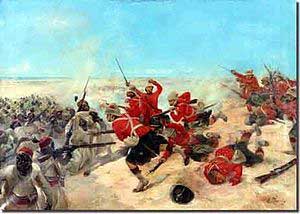
Hindustani (Urdu) to his list of languages.The Battle of Tel el Kebir
He saw action in the
Anglo-Egyptian war of 1882, particularly in the
Battle of Tel el-Kebir for which he was awarded a medal.
In 1885, as Sergeant, he was in Afghanistan showing his mapping skills.
A map, 6 inches to one mile, of the Panjdeh exists showing approximate Russian and Afghan positions on 30 Mar
1885.
Perhaps as a result of this he was promoted to Sub Lieutenant in 1885 and to Captain in 1891. He retired on
half pay in 1899, now aged 49.
His mother at this
time was living in Cannes (she died in
1909) and it seems he went to live there as he travels to and from
Marseilles many times over the next few years, saying on a 1921 Ship's
Passenger List, that France
was his country of permanent residence. He died in 1926 at Rathbone,
Northern Ireland.